The Best Fluffy Pancakes recipe you will fall in love with. Full of tips and tricks to help you make the best pancakes.

You have five pairs of jeans and you wear two outfits. Not because the other three pairs are wrong, but because nobody ever explained what goes on top of them.
That’s the whole problem with denim. The jeans are rarely the issue. The top is. Below are six formulas that work every time, why each one works, and what to do when you’re standing in front of the drawer with no idea where to start.
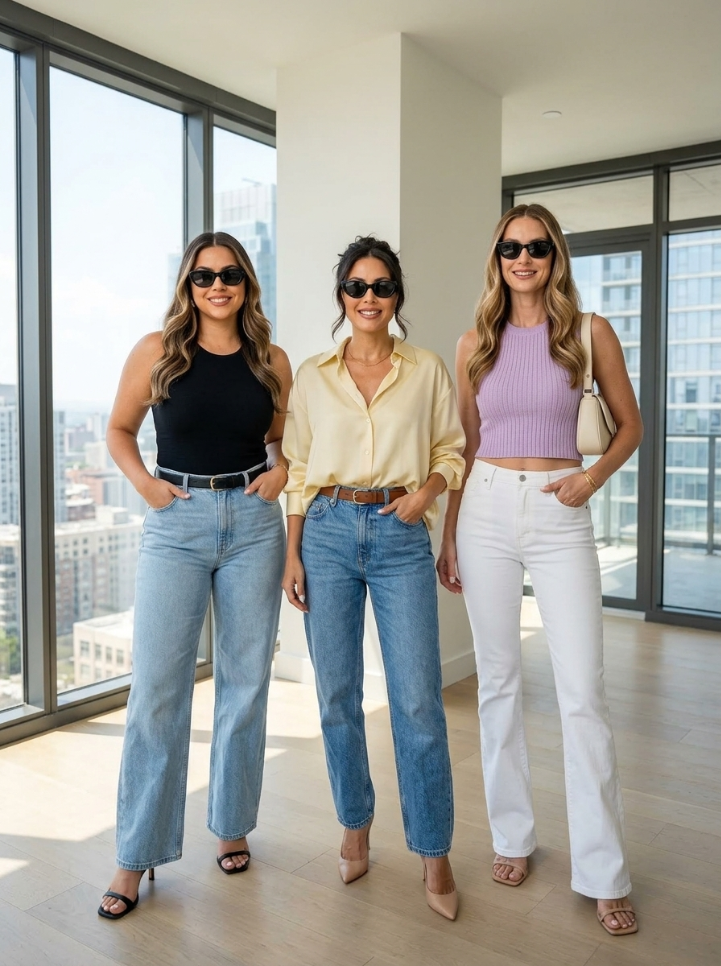
The Six Formulas At A Glance
| Jean cut | Pair it with | Why it works |
|---|---|---|
| Wide-leg | Fitted tank | Volume below, narrow above |
| Skinny | Blazer or oversized knit | Volume above, narrow below |
| Relaxed straight | Oversized button-down | Ease on ease, defined at the waist |
| White (any cut) | Tiny knit top | Minimal reads expensive |
| Straight-leg | Romantic blouse | Soft top, clean line below |
| Baggy | Baby tee | Cropped top keeps the waist |
Formula One: Fitted Tank + Wide-Leg Denim
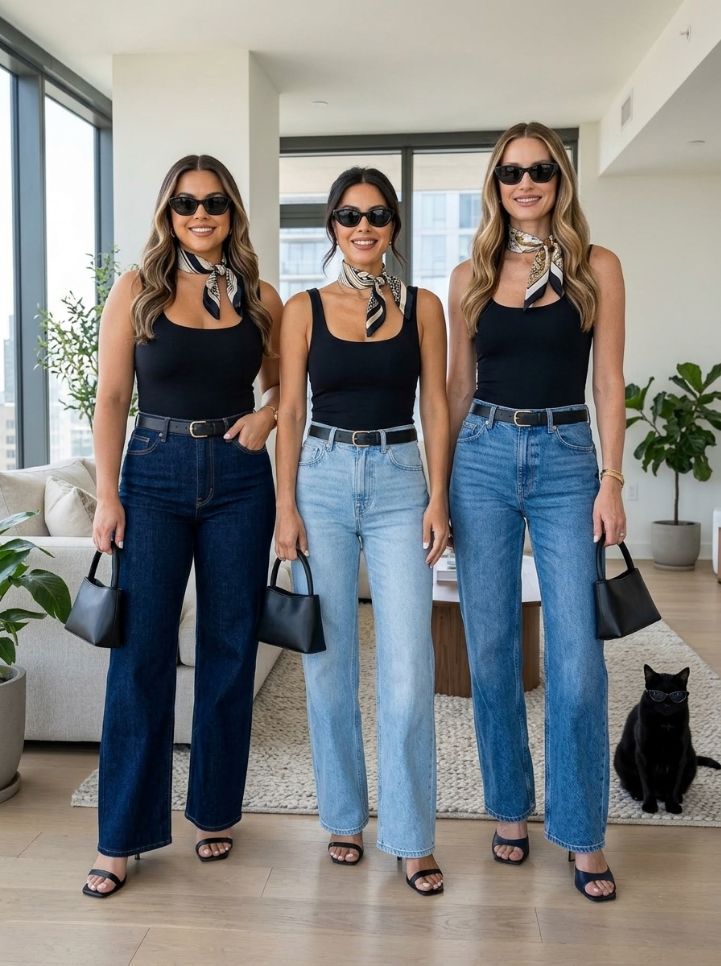
What it is. A close-fitting sleeveless tank, tucked in, with jeans that fall wide and straight from the hip.
Why it works. Wide-leg jeans carry a lot of fabric. Put anything loose on top and the whole silhouette becomes a column with no waist in it — you lose the shape entirely. A fitted tank does the opposite job: it marks where your waist is, so the volume below reads as a deliberate choice rather than an accident.
The right top. Ribbed cotton or fine knit. Scoop neck or square neck. It should end at the waistband or an inch below — long enough to tuck cleanly, short enough that it doesn’t bunch. Black is the easiest, cream is the softest, and both work with every wash.
What to avoid. An oversized tee. A boxy cropped top that ends above the waistband and leaves a gap of fabric doing nothing. Anything with a dropped shoulder, which widens the top half exactly where you need it narrow.
Finish it. A heeled sandal or a pointed shoe with some height — wide-leg jeans swallow a flat unless you’re going for a deliberately relaxed look. A small structured bag. A thin belt if the tank is tucked and the waistband is high.
Formula Two: Blazer + Skinny Jeans
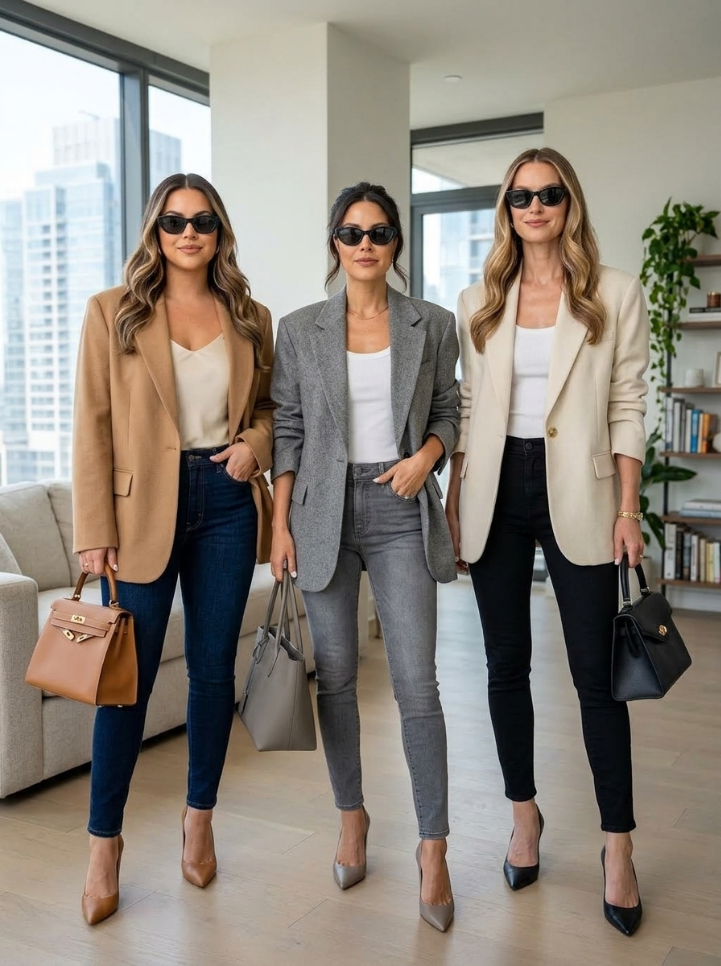
What it is. An oversized blazer worn open, over a plain fitted top, with skinny jeans.
Why it works. Skinny jeans went out of favour because everyone wore them with a fitted top, and tight-on-tight has nowhere to breathe. The jeans were never the problem. Put volume on the top half and the proportion inverts — now the narrow leg is the deliberate contrast, and the whole thing reads current instead of dated.
The right top. The blazer should be a size up from your usual, with a shoulder that sits slightly past your own. Underneath, keep it plain: a white tank, a fine-knit camisole, a simple tee. The blazer is the piece doing the work.
What to avoid. A fitted, nipped-waist blazer. It matches the jeans instead of balancing them and you end up with the 2014 version of this outfit. Also avoid anything cropped on top — short over narrow shortens the whole line.
Finish it. A pointed heel or a sleek ankle boot. A structured handbag with a defined shape. Keep jewellery minimal, because the blazer already has structure.
Formula Three: Oversized Button-Down + Relaxed Jeans
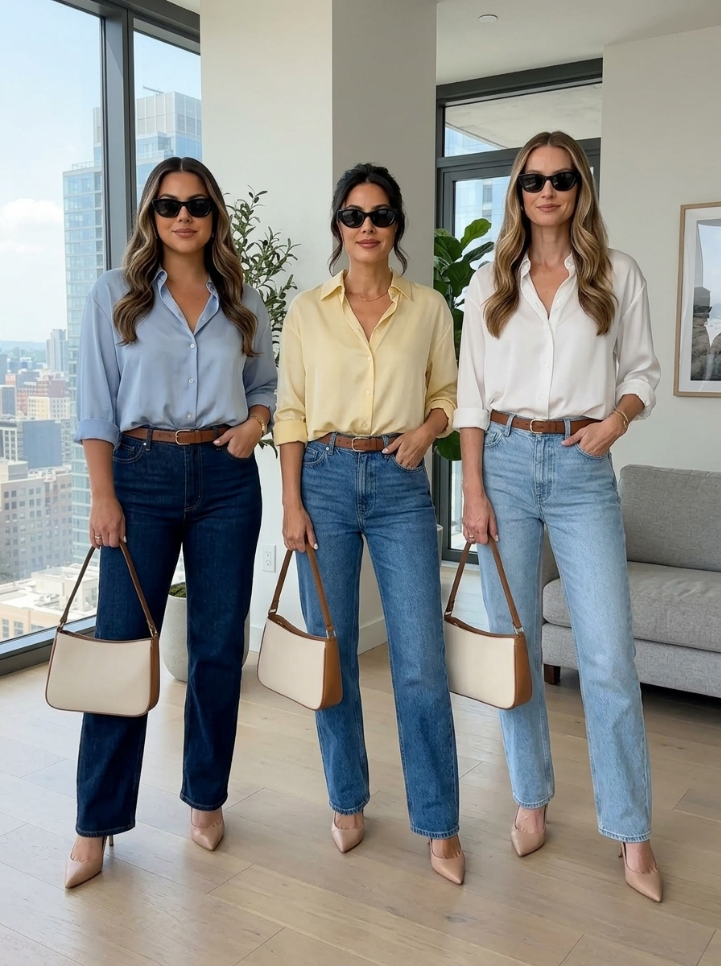
What it is. A loose silk or cotton shirt, sleeves rolled, half-tucked into relaxed straight jeans.
Why it works. This is the only formula on the list that puts ease on top of ease, and it works because of one detail: the tuck. Relaxed jeans have room through the hip and thigh, and an oversized shirt has room everywhere. Without a tuck, you disappear. Tuck the front only, leave the back loose, and you’ve drawn a waist through the middle of two loose garments.
The right top. Silk, poplin or fine cotton — something that drapes rather than holds its shape. Roll the sleeves to just below the elbow. Pale colours read expensive here: butter yellow, pale blue, cream, white.
What to avoid. Tucking the whole thing in, which flattens the shape and creates bulk at the waistband. Leaving it entirely untucked, which is the mistake most people make and the reason the outfit feels sloppy rather than relaxed.
Finish it. A brown leather belt visible at the front tuck — that’s what makes the half-tuck look intentional. A nude or tan shoe to keep the leg line long. A soft shoulder bag rather than a structured one.
Formula Four: Tiny Knit Top + White Jeans
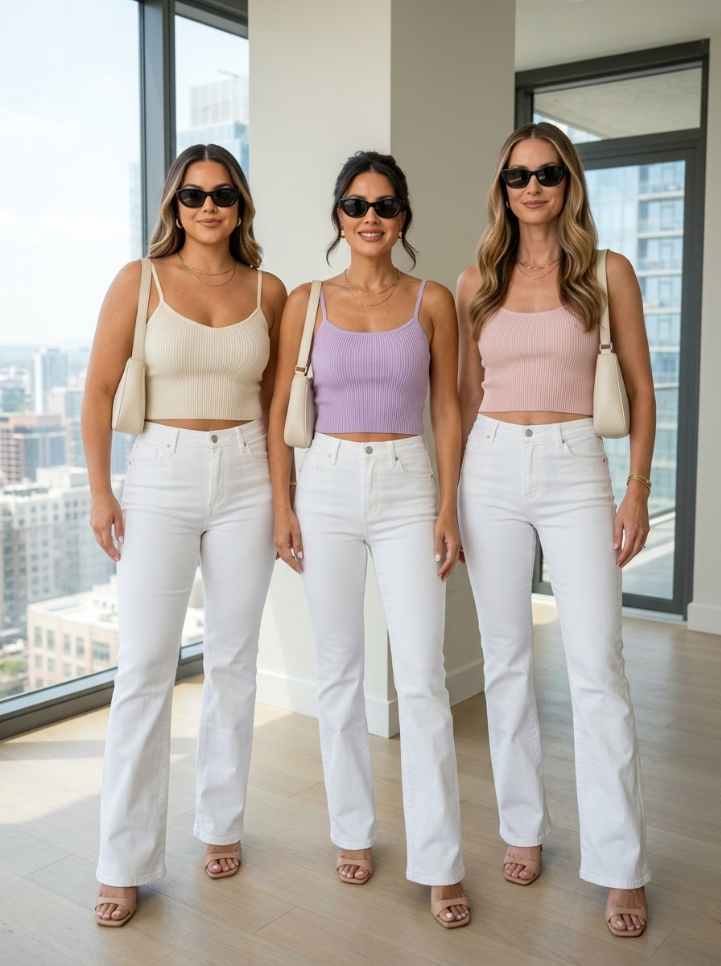
What it is. A small ribbed knit top with thin straps, with white jeans in any cut.
Why it works. This is the least complicated outfit on the list and it consistently reads as the most expensive. The reason is that there’s nothing in it to get wrong. White denim already looks considered — it’s the wash people associate with effort — and a plain knit top adds no competing detail. What you get is clean lines and one uninterrupted colour block from waist to floor.
The right top. Fine-gauge rib, fitted, ending at or just above the waistband. Lilac, cream, pale pink and soft sage all work. So does white, if you’re happy with a full tonal look.
What to avoid. Anything printed, anything with hardware, anything with a slogan. The formula depends on restraint. Also avoid a heavy chunky knit — the weight fights the lightness of the white denim.
Finish it. A nude or cream heeled sandal. A cream or straw bag. Gold jewellery, layered lightly. This is the one formula where a little jewellery helps rather than clutters.
Formula Five: Romantic Blouse + Straight-Leg Jeans
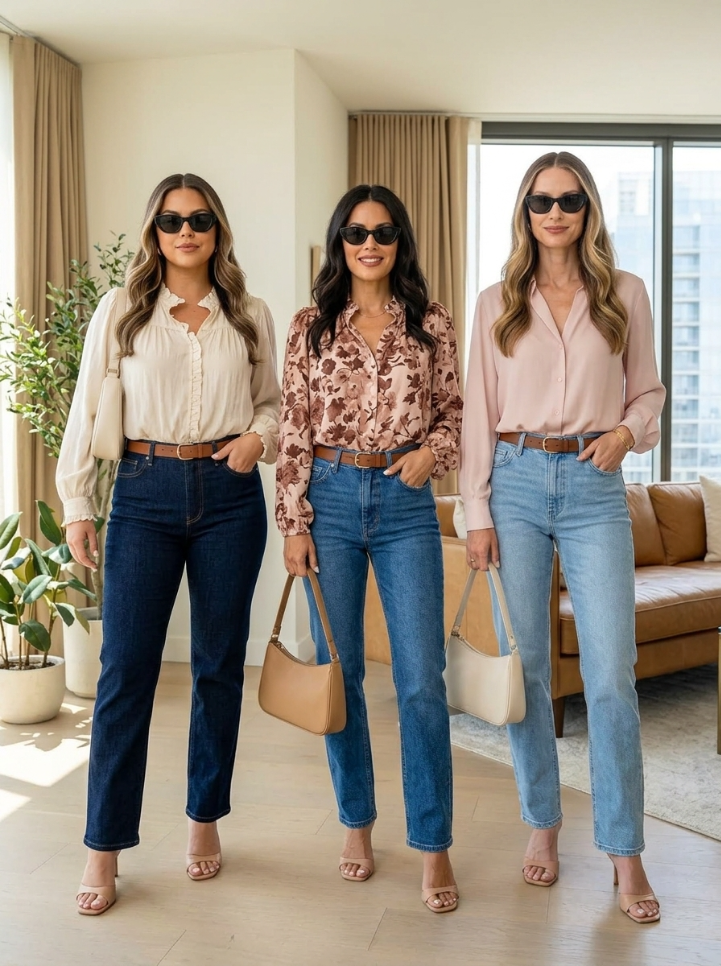
What it is. A soft blouse with volume in the sleeve — floral, ruffled or billowy — tucked into straight-leg jeans.
Why it works. Straight-leg jeans are the most neutral cut in your wardrobe. They don’t have a personality, which means they can carry a top that does. A blouse with print or movement gets somewhere to sit, and the clean vertical line of the jeans stops the whole thing tipping into costume.
The right top. Billowy sleeves, a soft neckline, and either a small print or a plain fabric with texture. Tuck it in fully — this is one formula where a full tuck beats a half-tuck, because you want the volume concentrated above the waist, not spilling over it.
What to avoid. Pairing a romantic blouse with a wide-leg or flare. Soft on top and wide below is too much movement in one outfit, and the shape gets lost. Straight-leg is the right degree of plainness.
Finish it. A brown belt at the waist. A heeled sandal or a low block heel. A small cream or tan bag. If the blouse has a print, pull your accessory colour from the darkest shade inside it.
Formula Six: Baby Tee + Baggy Jeans
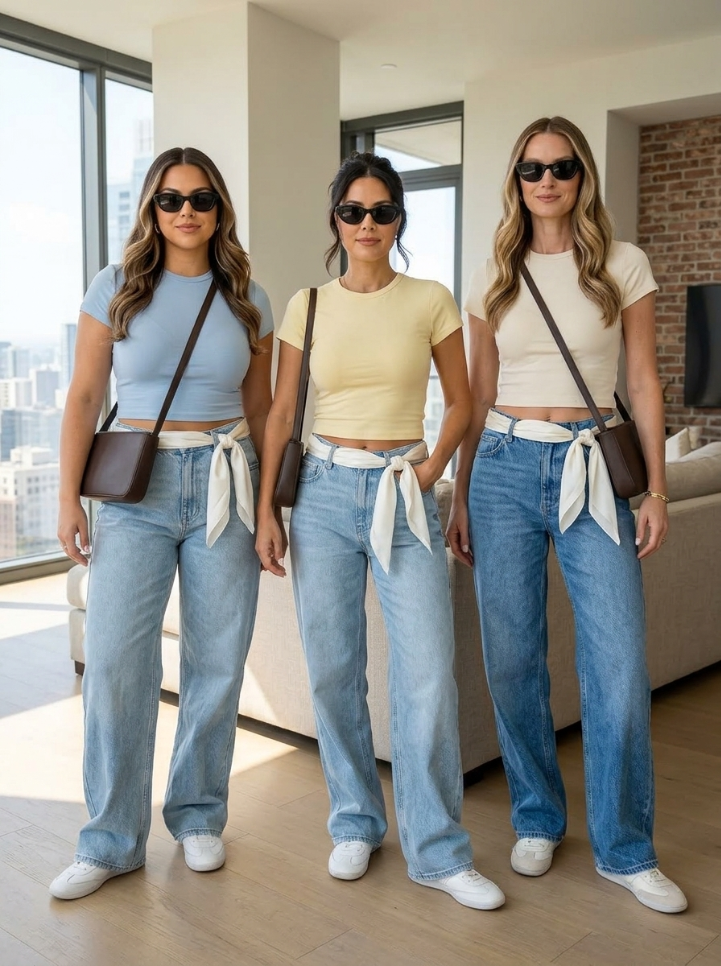
What it is. A cropped, close-fitting short-sleeve tee with baggy wide-leg jeans.
Why it works. Baggy jeans have more volume than any other cut, and they sit low and full through the leg. A cropped tee is the counterweight — it keeps the waist visible and stops the outfit reading as two large pieces stacked on top of each other. It’s the same logic as formula one, taken further because the jeans are bigger.
The right top. Fitted, short sleeve, ending right at or just above the waistband. Pale yellow, pale blue, cream and white all work better than black here — baggy jeans already read casual, and a soft colour keeps it looking styled rather than thrown on.
What to avoid. A long or oversized tee. It covers the waistband, the eye loses the waist, and you end up with a rectangle. Also avoid a heavy shoe — a chunky boot under baggy denim adds weight at both ends.
Finish it. Clean white sneakers or a flat mule. A shoulder bag in a darker colour for contrast. A silk scarf tied at the waistband is the small detail that lifts this from casual to considered.
Jean Cuts, Explained
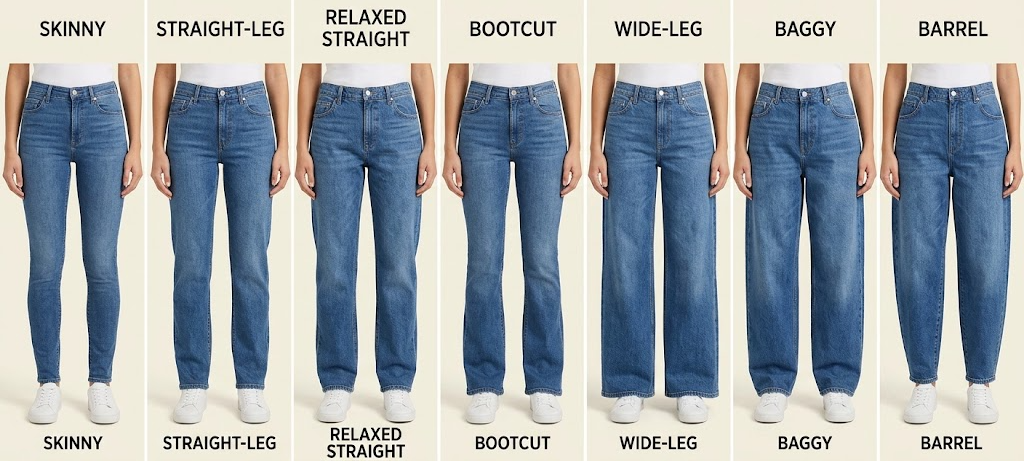
Most people can’t name what’s in their own drawer, which makes every styling article harder to use than it needs to be. Here’s the short version.
Skinny. Narrow from hip to ankle, close to the leg the whole way down. Usually stretch denim.
Straight-leg. The same width from knee to hem, falling straight rather than tapering. The most versatile cut you can own.
Relaxed straight. Straight through the leg but with extra room in the hip and thigh. Sits between straight and baggy.
Bootcut. Fitted through the thigh, then widening from the knee down. The flare is gradual, not dramatic.
Wide-leg. Wide from the hip all the way to the hem, with a consistent line. No taper anywhere.
Baggy. Wider than wide-leg, and looser through the seat and thigh. The volume starts higher on the body.
Barrel. Curved — roomy through the thigh, then tapering back in toward the ankle. The leg has a rounded shape rather than a straight one.
Where The Hem Should Sit
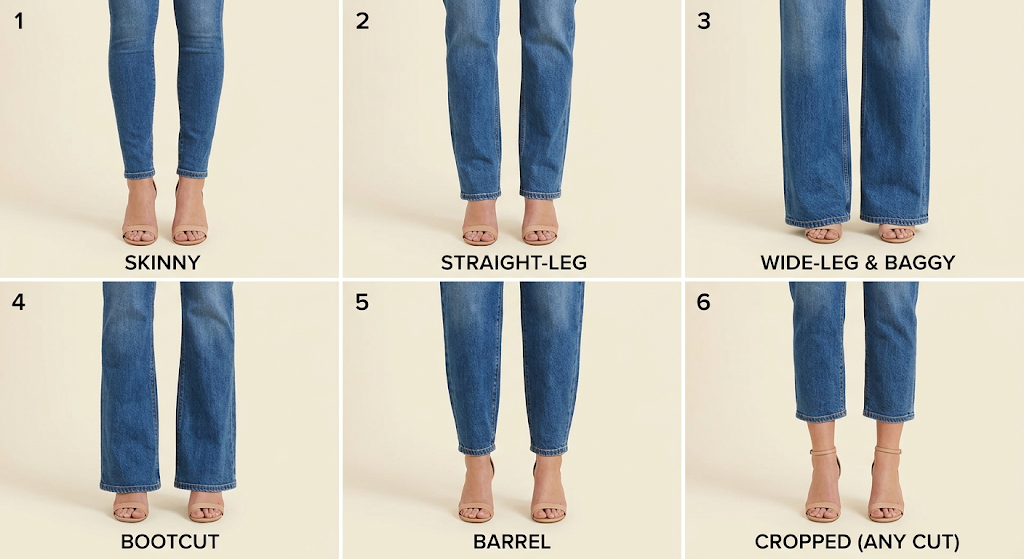
Hem length changes the length of your leg more than the cut does. Here’s where each one wants to fall.
Skinny: at the ankle bone or just above it. Never bunched at the ankle, which shortens the leg and adds bulk at the narrowest point.
Straight-leg: brushing the top of the shoe with a slight break. A full break puddles; no break at all reads as accidentally short.
Wide-leg and baggy: just skimming the floor when you’re in the shoes you’ll wear. This is the one cut where you hem to the shoe, not the other way round. Too short and the proportion collapses immediately.
Bootcut: covering most of the shoe, ending about a centimetre above the ground. The flare needs the length to read as a flare.
Barrel: at the ankle or just above, so the taper is visible. Cover the ankle and the shape disappears.
Cropped, any cut: at the narrowest part of your lower calf, just above the ankle bone. Avoid the widest part of the calf — a hem that lands there will shorten your leg no matter how well the jeans fit.
Where The Waistband Should Sit
High rise sits at or just above the natural waist. It’s the easiest rise to style because it gives you a clear waistline to tuck into, and it works with every formula on this list.
Mid rise sits below the navel. It works, but you lose the defined waist, so tucking matters more and cropped tops are harder to balance.
Low rise sits on the hip. It needs a cropped or fitted top and it’s the least forgiving of the three. If you’re wearing low rise, keep everything above the waist simple.
If you’re buying and you’re unsure, buy high rise. It gives you the most outfits.
If You Only Own One Pair
Buy a straight-leg in a mid-blue wash first. It carries more tops than any other cut, dresses up with a heel and down with a sneaker, and it doesn’t date the way skinny or extreme wide-leg does.
Buy a wide-leg in a dark wash second. It gives you a completely different silhouette from the same wardrobe, which effectively doubles your outfit count without doubling your drawer.
Buy white third, once you’ve got the shapes covered. White denim is the highest-impact, lowest-effort pair you can own, but it’s a third pair rather than a first.
The One Rule Underneath All Six
Every formula on this list is the same idea in different clothes: whatever the jeans are doing, the top does the opposite.
Wide below wants narrow above. Narrow below wants volume above. Loose on loose only works if you put a waist through the middle. Busy on the bottom wants quiet on top.
Once you have that, you don’t need the list. You can look at any pair of jeans you own — including ones that aren’t in this post — and work out what belongs on top of them.